Humanoid Robots Revolutionize Surgery with Affordable Remote Medical Breakthrough
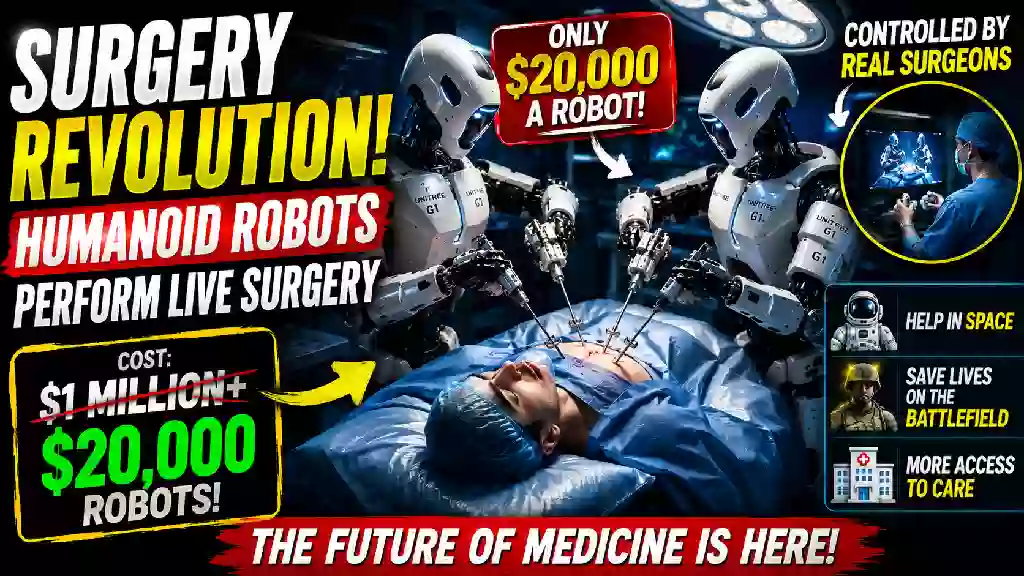
A conceptual illustration of affordable humanoid robots performing remotely controlled surgery, highlighting a major breakthrough in robotic-assisted healthcare that could improve access to medical care in rural communities, emergency situations, and remote locations.
Humanoid Robots Revolutionize Surgery with Affordable Remote Medical Breakthrough
Low-Cost Humanoid Robots Could Transform the Future of Remote Surgery
A major breakthrough in medical technology is bringing the future of healthcare closer than ever. Researchers at the University of California San Diego have successfully demonstrated remote surgery using affordable humanoid robots, marking a significant advancement that could reshape emergency medicine, rural healthcare, and surgical accessibility worldwide.
Unlike traditional surgical robots that often cost more than $1 million, the new humanoid robots used in the trial are priced at approximately $20,000 each, making advanced robotic-assisted surgery dramatically more affordable for hospitals and healthcare providers.
The successful demonstration highlights the growing role of robotics and artificial intelligence in modern medicine while opening new possibilities for delivering expert surgical care to patients in remote or dangerous environments.
Successful Remote Surgery Demonstration
During the groundbreaking trial, two Unitree G1 humanoid robots were remotely controlled by experienced surgeons who successfully performed gallbladder surgery on a pig. The procedure demonstrated that affordable humanoid robots can accurately execute complex surgical movements under the direct supervision of trained medical professionals.
Importantly, the robots were not operating autonomously. Instead, surgeons controlled every movement remotely using specialized controls, ensuring precision throughout the procedure.
Medical experts say this distinction is critical, as the technology is designed to extend the reach of skilled surgeons rather than replace them.
Expanding Access to Healthcare
One of the biggest advantages of remote robotic surgery is its potential to provide life-saving medical care in locations where surgeons are unavailable.
Healthcare professionals believe this technology could eventually benefit:
- Rural hospitals with limited specialist access
- Military personnel injured on the battlefield
- Astronauts during long-duration space missions
- Disaster response teams operating in remote areas
- Patients in underserved regions around the world
In situations where transporting a patient to a hospital may be impossible, remote surgery could become the difference between life and death.
Affordable Technology Changes the Equation
Traditional robotic surgical systems have long been praised for their precision but criticized for their high cost, limiting their availability to major medical centers.
Researchers instead adapted commercially available humanoid robots, proving that advanced surgical capabilities may no longer require million-dollar equipment.
The lower price point could allow more hospitals, universities, and healthcare systems to adopt robotic-assisted surgery, potentially improving patient access while reducing healthcare costs over time.
Although the current system experiences minor communication delays between the surgeon and robot, researchers believe ongoing improvements in networking and robotics will continue to reduce latency and improve overall performance.
Human Expertise Remains Essential
Despite rapid advances in artificial intelligence, experts emphasize that today’s robotic surgical systems still depend entirely on trained surgeons.
The robots function as sophisticated medical tools rather than independent decision-makers. Every incision and movement remains under direct human control.
Many healthcare professionals view this human oversight as essential for maintaining patient safety while allowing technology to enhance surgical capabilities instead of replacing physicians.
Growing Public Interest in AI and Robotics
The surgical breakthrough comes as artificial intelligence continues expanding into many aspects of everyday life.
However, public opinion remains divided. Recent polling cited during the discussion found that only a small percentage of Americans consider AI “very useful” in their daily lives, while many remain cautious about widespread adoption.
Privacy, cybersecurity, and trust continue to be major concerns whenever connected robotic systems enter homes or healthcare facilities.
Nevertheless, successful medical applications like remote surgery could help increase public confidence by demonstrating tangible benefits that improve patient outcomes.
The Future of Robotic Medicine
Researchers believe this achievement represents only the beginning of a new era in robotic healthcare.
As artificial intelligence, robotics, and telecommunications continue advancing, remote robotic surgery could become a standard tool for emergency medicine, military healthcare, humanitarian missions, and specialized medical treatment in underserved communities.
While additional clinical testing and regulatory approval will be required before widespread human use, the successful demonstration shows that affordable humanoid robots may soon play a critical role in expanding access to high-quality surgical care across the globe.
The combination of lower costs, expert remote control, and expanding technological capabilities positions robotic-assisted medicine as one of the most exciting developments in modern healthcare.
#HumanoidRobots #RoboticSurgery #RemoteSurgery #MedicalTechnology #HealthcareInnovation #ArtificialIntelligence #AIHealthcare #SurgicalRobots #FutureOfMedicine #HealthTech