Commercial Tankers Struck in Strait of Hormuz as US Plans Maritime Blockade on Iran
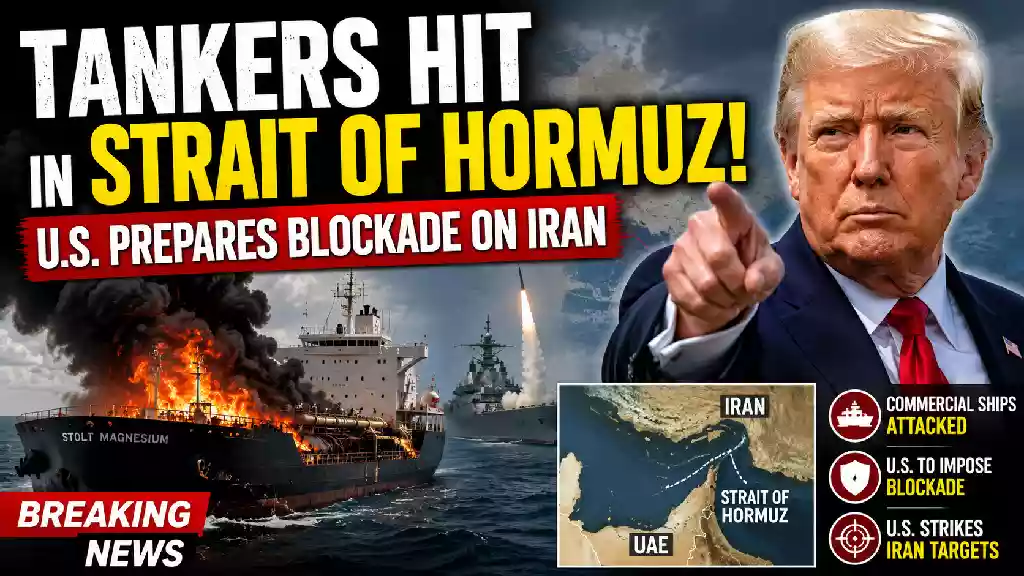
A dramatic illustration of the escalating crisis in the Strait of Hormuz, highlighting attacks on commercial tankers, the proposed U.S. maritime blockade targeting Iran, and growing concerns over global oil supplies and regional security.
Commercial Tankers Struck in Strait of Hormuz as US Plans Maritime Blockade on Iran
US Military Operations Intensify Following Attacks on Commercial Shipping
Tensions in the Middle East escalated after multiple commercial vessels were struck in the Strait of Hormuz, as the United States prepared to implement a new maritime blockade targeting Iranian trade. The developments come amid continued U.S. military strikes against Iranian coastal infrastructure, raising concerns over regional stability, global shipping, and energy markets.
According to the report, Dutch shipping company Stolt Tankers confirmed that its Liberia-flagged tanker Stolt Magnesium was struck while transiting the strategic waterway. The attack ignited a fire in the vessel’s engine room, though all crew members were safely accounted for. The apparent precision of the strike has drawn attention from maritime security experts monitoring the growing risks to commercial shipping in the Gulf.
The report also stated that two tankers linked to the United Arab Emirates were hit in separate incidents, leaving one crew member dead. The attacks have renewed concerns that the conflict could disrupt one of the world’s busiest maritime trade corridors.
U.S. Announces Blockade Targeting Iranian Trade
President Donald Trump announced that the United States intends to impose a blockade aimed at restricting maritime commerce involving Iran. According to the announcement, vessels conducting business with Iran would be prevented from transiting the Strait of Hormuz, while ships not engaged in Iranian trade would continue to pass through the waterway. The administration also proposed a 20% security reimbursement fee for vessels using the route.
The Strait of Hormuz is one of the world’s most strategically important shipping lanes, serving as a major transit route for global crude oil exports. Any disruption to traffic through the narrow passage can have significant consequences for international energy supplies and global markets.
U.S. Expands Strikes on Iranian Maritime Targets
The planned blockade follows another round of U.S. military operations targeting Iranian coastal facilities. According to U.S. Central Command, recent strikes focused on maritime infrastructure, missile and drone launch capabilities, and naval assets along Iran’s southern coastline.
Among the reported targets were facilities in Bandar Abbas, including a ship repair yard and a submarine installation. The military also said it employed sea drones during the operation, marking the first reported combat use of the technology against enemy targets. Additional strikes were reported near Kish Island, where fires were observed following the attacks.
Diplomatic Tensions Continue to Rise
The Trump administration has said the increased military and economic pressure is intended to encourage Iran to return to negotiations. However, Iranian officials continue to accuse the United States of escalating the conflict rather than pursuing diplomacy.
The report also referenced allegations of another plot targeting President Trump, underscoring the heightened security concerns surrounding the ongoing confrontation.
Oil Prices Edge Higher as Markets Monitor Developments
Financial markets reacted cautiously to the latest developments. According to the report, benchmark crude oil prices fluctuated between approximately $79 and $80 per barrel following the announcement of the blockade. While stocks declined modestly, oil prices remained below the peaks seen earlier in the year, when crude traded above $100 per barrel. Average gasoline prices in the United States were also reported to be lower than previous highs despite the recent increase.
Market analysts quoted in the report suggested the administration’s actions may be part of a broader negotiating strategy intended to increase pressure on Tehran while limiting long-term economic disruption. Even so, continued attacks on commercial shipping and uncertainty surrounding the Strait of Hormuz are expected to keep energy markets and global shipping companies on alert.
As the proposed blockade moves forward and military operations continue, governments and industry leaders will be closely watching whether diplomatic efforts can ease tensions or whether the confrontation develops into a broader regional crisis with far-reaching economic consequences.
#BreakingNews #StraitOfHormuz #Iran #USA #DonaldTrump #MiddleEast #WorldNews #Geopolitics #GlobalNews #MaritimeSecurity