US Airstrikes Intensify Middle East Crisis as Iran Announces Strait of Hormuz Closure
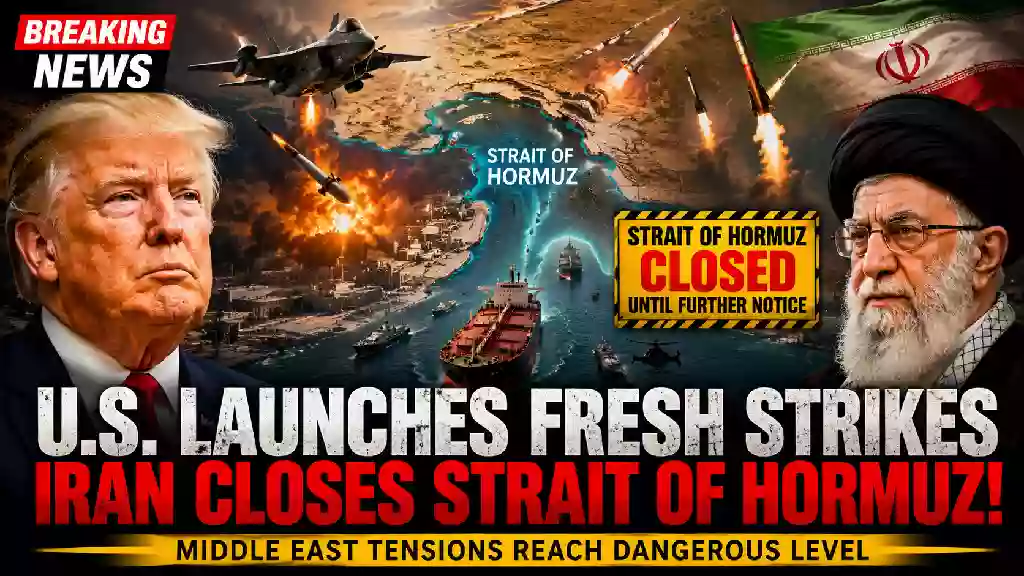
A breaking news illustration depicting the latest escalation in the U.S.-Iran conflict, with fresh U.S. airstrikes, Iran's announcement regarding the Strait of Hormuz, and rising security concerns across the Middle East.
US Airstrikes Intensify Middle East Crisis as Iran Announces Strait of Hormuz Closure
Washington and Tehran Exchange Fresh Military Blows While Gulf Nations Brace for Further Escalation
The conflict between the United States and Iran entered another dangerous phase after U.S. forces carried out a new series of airstrikes against Iranian military targets, prompting Tehran to announce the closure of the Strait of Hormuz. The latest escalation has heightened security concerns across the Gulf region, with neighboring countries activating emergency measures and global markets closely monitoring one of the world’s most important maritime trade routes.
According to U.S. Central Command, American forces struck approximately 140 Iranian military sites, including missile launch facilities, drone infrastructure, weapons depots, and ammunition storage locations. The operation followed recent attacks attributed to Iran against U.S. interests and commercial shipping in the region.
Iran Responds with Missile Attacks and Shipping Restrictions
Iran’s Islamic Revolutionary Guard Corps (IRGC) released footage that it said showed missiles being launched toward U.S. military targets in the Middle East. Iranian officials also announced that the Strait of Hormuz had been closed until further notice after claiming responsibility for disabling another vessel operating in the strategic waterway.
The Strait of Hormuz is one of the world’s busiest energy corridors, carrying a substantial share of global oil and liquefied natural gas exports. Any disruption to maritime traffic through the narrow passage has the potential to affect international energy supplies, shipping operations, and financial markets.
Iran has maintained that vessels should follow navigation routes it designates near its coastline, describing the measure as part of its sovereign authority. The United States, however, continues to reject any claim that Tehran controls international navigation through the strait, keeping tensions over freedom of navigation at the center of the dispute.
Gulf States Raise Security Alert
The renewed confrontation has prompted several Gulf countries to strengthen their security posture.
Authorities in Bahrain urged residents to seek shelter following reports of aerial threats, while Kuwait placed its armed forces on heightened alert and condemned missile launches directed toward its territory as a dangerous escalation. In Qatar, officials reported that three people, including a child, were injured after debris from intercepted missiles fell into populated areas.
Maritime security has also come under increasing pressure. The United Kingdom Maritime Trade Operations reported that a commercial container ship east of Oman sustained damage and caught fire, forcing its crew to abandon the vessel. Indian authorities confirmed that ten nationals were rescued from the incident, while one person remained missing.
Strategic Importance of the Strait of Hormuz
Analysts continue to view the Strait of Hormuz as one of Iran’s most significant strategic assets. Control over access to the waterway has long provided Tehran with leverage during periods of diplomatic and military tension.
The latest incidents suggest that Iran is seeking to reinforce its influence over shipping routes, while the United States remains committed to maintaining freedom of navigation through international waters. Each new attack on commercial vessels has been followed by military retaliation, creating a cycle that has become increasingly difficult to break.
Diplomatic Efforts Face Mounting Pressure
Despite the escalating military confrontation, diplomatic discussions remain scheduled in Amman, where officials hope to prevent the conflict from widening.
The talks, however, are expected to take place under exceptionally difficult circumstances. Relations between Washington and Tehran have deteriorated following repeated military exchanges and disagreements over the status of an earlier memorandum of understanding (MOU).
Iranian officials argue that the agreement has been violated, while President Donald Trump has stated that the previous ceasefire arrangement is no longer in effect. Whether negotiators can revive the framework or establish a new path toward de-escalation remains uncertain.
Global Markets Monitor Regional Instability
The latest developments have renewed concerns over global energy security as governments, shipping companies, and financial markets assess the risks posed by continued instability in the Gulf.
Any prolonged disruption to shipping through the Strait of Hormuz could have far-reaching consequences for crude oil exports, international trade, and fuel prices worldwide. Industry observers are also watching for possible increases in shipping insurance costs and further adjustments to commercial maritime routes.
With military operations continuing and diplomatic negotiations facing significant obstacles, international attention remains focused on whether both sides can prevent the conflict from expanding into a broader regional crisis.
#USIranConflict #StraitOfHormuz #MiddleEast #BreakingNews #Iran #UnitedStates #WorldNews #Geopolitics #GlobalSecurity #OilMarkets
Keane: U.S. Actions Could Put Iran’s Regime on a “Pathway to Collapse”
Trump Administration Reports Increased Shipping Activity as Iran Talks Continue