Oklahoma Ethics Commission Weighs AI Disclosure Rules for Political Campaign Ads
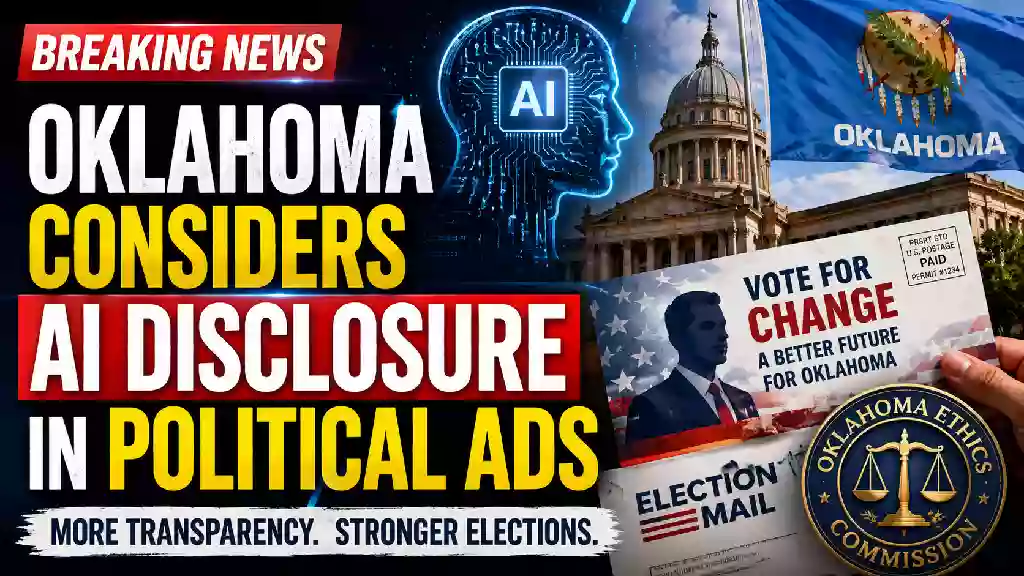
The Oklahoma Ethics Commission is considering new rules that would require political candidates to disclose when artificial intelligence is used in campaign advertisements, a proposal aimed at increasing election transparency and voter trust.
Oklahoma Ethics Commission Weighs AI Disclosure Rules for Political Campaign Ads
Oklahoma Officials Consider New Transparency Rules for AI-Generated Political Advertising
As artificial intelligence continues to reshape political campaigning across the United States, Oklahoma officials are considering new rules that would require candidates to disclose when artificial intelligence is used in campaign advertisements. The proposal, currently under review by the Oklahoma Ethics Commission, reflects growing concerns over election transparency, voter trust, and the rapid expansion of AI-generated political content.
Artificial intelligence has become increasingly common in political advertising, allowing campaigns to create realistic images, videos, voiceovers, and promotional materials more quickly and at lower cost. While the technology offers new creative opportunities, critics argue that AI-generated campaign ads can blur the line between authentic and fabricated content, making it more difficult for voters to distinguish fact from fiction.
AI Campaign Ads Becoming More Common
Many Oklahoma voters may not realize they have already encountered AI-generated political advertisements. Whether arriving in mailboxes, appearing on television, or circulating through social media platforms, AI-created campaign materials are becoming an increasingly visible part of election seasons.
Currently, Oklahoma law does not require political candidates or campaign organizations to disclose whether artificial intelligence was used to create campaign advertisements. That lack of transparency has prompted discussions among state officials about whether disclosure requirements should become part of Oklahoma’s campaign finance regulations.
The Oklahoma Ethics Commission says the issue became more urgent following the most recent election cycle, during which artificial intelligence played a significantly larger role in political messaging than in previous years.
Ethics Commission Examines Possible Rule Changes
According to the Oklahoma Ethics Commission, the conversation began after concerned voters reported receiving campaign mailers that appeared to have been created using artificial intelligence. Additional complaints involved television commercials that allegedly relied on AI-generated content.
Those concerns encouraged commissioners to begin researching how other states are responding to the growing influence of artificial intelligence in politics.
Commission members acknowledge that AI technology is evolving rapidly and is likely to become a permanent feature of future political campaigns. Rather than waiting for widespread misuse, officials believe now is the appropriate time to consider updating campaign finance rules to address emerging technology.
Maryland’s AI Disclosure Law Serves as a Model
As part of its review, the Oklahoma Ethics Commission recently examined Maryland’s approach to regulating AI in political campaigns.
Maryland’s framework includes two primary components. First, it requires disclosure when artificial intelligence is used in campaign communications, giving voters additional context about the content they are viewing. Second, it establishes criminal penalties for individuals who intentionally use AI to deceive or defraud voters.
Oklahoma officials noted that while disclosure requirements could fall under the authority of the Ethics Commission, criminal penalties would likely require action by the Oklahoma Legislature.
Commission members indicated that Oklahoma may ultimately adopt a disclosure-focused approach similar to Maryland’s model, emphasizing transparency rather than imposing immediate criminal sanctions.
Changes Unlikely Before Current Election Cycle
Although discussions are moving forward, any new disclosure requirement will not affect the current election cycle.
Before any proposed rule can take effect, it must receive approval from the Oklahoma Legislature. That legislative process means candidates participating in upcoming elections will continue operating under existing rules, which do not require AI disclosures in political advertising.
Still, Ethics Commission officials suggested that new transparency standards could become reality in future election cycles as lawmakers continue evaluating the role of artificial intelligence in democratic processes.
Transparency Becomes Central Election Issue
Election experts increasingly warn that artificial intelligence has the potential to transform political communication. AI tools can generate highly realistic videos, manipulate voices, produce convincing images, and rapidly create customized campaign messages targeted at specific audiences.
Supporters of disclosure requirements argue that voters deserve to know when artificial intelligence has played a role in creating political advertisements. They believe transparency can strengthen public confidence while allowing campaigns to continue using innovative technology responsibly.
Opponents of additional regulation caution that overly restrictive rules could create compliance challenges for campaigns and limit the beneficial uses of AI in political communication.
As more states explore similar legislation, Oklahoma’s debate reflects a broader national conversation about balancing technological innovation with election integrity and public trust.
For now, Oklahoma voters concerned about campaign advertisements can seek guidance and report issues through the Oklahoma Ethics Commission while state officials continue evaluating potential policy changes aimed at improving transparency in political advertising.
#Oklahoma #ArtificialIntelligence #PoliticalAds #ElectionIntegrity #CampaignFinance #AI #Election2026 #Transparency #Politics #AITechnology